High-Fiber Foods for IBS: What Helps and What Makes It Worse
Not all fiber helps IBS. Soluble fiber soothes symptoms — insoluble fiber can worsen them. Here are the safe high-fiber foods for IBS.
High-Fiber Foods for IBS: What Helps and What Makes It Worse
The standard health advice — eat more fiber — backfires for a lot of people with irritable bowel syndrome. They double their fiber intake on the assumption that more is better, and within a week the bloating, cramping, and urgency get worse, not better. The problem is that “fiber” is not one thing. Soluble fiber and insoluble fiber behave in opposite ways inside an irritable gut, and the NICE clinical guideline CG61 is explicit: people with IBS “should be discouraged from eating insoluble fibre (for example, bran).”
What works depends on which type of IBS you have. IBS-C (constipation-predominant) responds well to soluble fiber, which absorbs water and softens stool. IBS-D (diarrhea-predominant) tolerates soluble fiber but reacts badly to insoluble fiber, which speeds transit and worsens loose stools. Most people swing between both, and the practical answer is the same in either case: lean hard on soluble fiber, go easy on insoluble. Fiber type is one piece of the dietary picture — our guide on IBS food triggers covers the wider list of trigger and safe foods, and this article focuses on the fiber question specifically. The lists below match foods to that rule, including the overlap with low-FODMAP diet safe portions.
Soluble vs Insoluble Fiber — Which One Helps IBS?
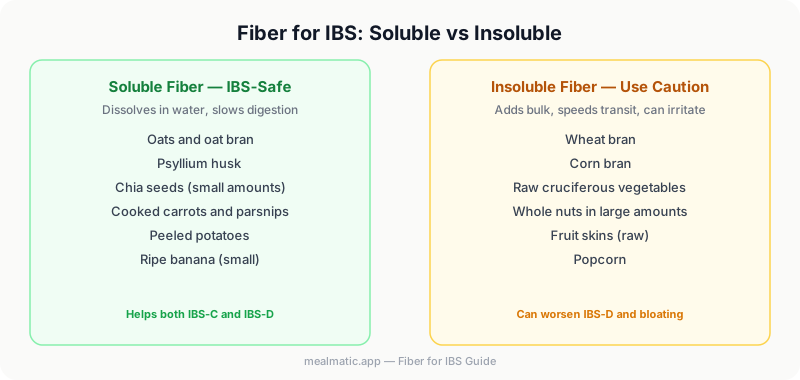
Soluble fiber dissolves in water and forms a gel inside the gut. The gel slows down digestion, holds water, and softens stool without irritating the bowel wall. That mechanism helps both ends of the IBS spectrum: it bulks loose stools in IBS-D and softens hard stools in IBS-C. Foods rich in soluble fiber include oats, psyllium husk, peeled potatoes, carrots, and ripe bananas.
Insoluble fiber does the opposite. It does not dissolve — it adds physical bulk and accelerates transit through the colon. In a healthy gut that’s useful. In a hypersensitive IBS gut, it can trigger cramping, gas, and urgency. The classic offender is wheat bran, which is exactly why both NICE and the NHS guidance for IBS tell IBS-D patients to “cut down on high-fibre foods like wholegrain foods (such as brown bread and brown rice), nuts and seeds.”
The cleanest summary of the evidence is the Ford et al. 2008 BMJ meta-analysis, which pooled 12 fiber trials covering 591 IBS patients. Across all fiber types combined, the effect was barely significant. When the authors split soluble from insoluble fiber, the benefit was “limited to ispaghula” (the soluble form of psyllium), with a relative risk of persistent symptoms of 0.78 versus placebo (95% CI 0.63 to 0.96). Bran trials showed no meaningful effect at all. That single split is the reason every modern IBS guideline now distinguishes the two types.
Best Soluble Fiber Foods for IBS
The list below covers the soluble-fiber sources that show up across NHS, NICE, and Monash University recommendations. Approximate fiber amounts come from USDA FoodData Central or the Monash FODMAP database where serving thresholds matter.
Oats and oat bran. Rolled oats are the most-cited soluble fiber food for IBS. The active compound is beta-glucan, which forms a thick gel in the small intestine. NICE specifically names “oats” as a recommended soluble fiber source. A half-cup uncooked serving (52g) is also low FODMAP per Monash University and provides about 4g of fiber, the majority soluble. Steel-cut oats work the same way at similar small servings. Quick oats become triggering above ~23g uncooked.
Psyllium husk (ispaghula). Whole psyllium husk delivers around 3.5g of fiber per tablespoon (5g), and ground psyllium powder roughly 6-7g per 9g scoop, with most of it soluble. The strongest single piece of evidence in IBS dietary research is Bijkerk et al. 2009 in BMJ, a 12-week three-arm trial of 275 patients comparing 10g/day of psyllium, 10g/day of bran, and rice flour placebo. By the end of month 1, psyllium produced adequate symptom relief in 57% of patients versus 35% on placebo (relative risk 1.60). Bran did not separate from placebo until month 3 and had the highest dropout rate of the three arms.
Chia seeds. Two tablespoons (24g) of dried chia seeds is the Monash low-FODMAP cap and supplies around 8g of fiber, mixed soluble and insoluble. Above 24g per serving the polyol load can trigger gas. Soaking the seeds first (chia pudding made overnight in lactose-free milk or water) lets the soluble fraction gel before you eat it, which most people tolerate better than dry seeds sprinkled on top of yogurt.
Cooked carrots and parsnips. Cooking breaks down the cell walls and converts some of the cellulose into a softer matrix the gut tolerates better. USDA lists cooked carrots at roughly 2.8g of fiber per 100g, mostly pectin (soluble) once heated. Both are flagged as low FODMAP at standard serving sizes and appear by name in the NHS list.
Peeled potatoes. Peeling removes most of the insoluble skin fiber and leaves the soluble starch and pectin in the flesh. The NHS names peeled potatoes specifically among “good foods” for soluble fiber. Mashed, boiled, or baked all work. Skin-on baked potatoes flip back to insoluble-dominant and become harder for IBS-D.
Ripe bananas (small). A small firm-but-ripe banana of about 100g (Cavendish, just-yellow, no brown spots yet) is low FODMAP and supplies around 2g of fiber, mostly soluble pectin. Overripe bananas (brown spots, soft) cross into high FODMAP because the starch has converted to fructose. Hard green bananas have more resistant starch but can be triggering for some IBS-D patients.
Linseeds (flaxseed). The NHS recommendation is precise: “up to 1 tablespoon of linseeds (whole or ground) a day.” That’s roughly 7g of seed yielding 2-3g of fiber, with the soluble fraction (mucilage) the part that helps. Going above one tablespoon adds insoluble bulk that can backfire. Ground releases the mucilage faster than whole.
High-Fiber Foods to Avoid with IBS
These foods are widely promoted as “healthy high-fiber choices” in mainstream nutrition advice, but the fiber is overwhelmingly insoluble or fermentable in ways that an IBS gut tolerates badly.
Wheat bran. The single most-cited problem food in IBS literature. NICE names bran by example as the insoluble fiber to avoid. Bran flakes, raw wheat germ, all-bran cereals, and bran muffins fall in the same group.
Whole-grain wholewheat bread and brown rice. The NHS specifically lists “wholegrain foods (such as brown bread and brown rice)” among the foods to cut down on for diarrhea-predominant IBS. White rice and white sourdough are usually fine in moderate portions.
Raw cruciferous vegetables. Raw broccoli, cauliflower, Brussels sprouts, and cabbage combine insoluble fiber with raffinose-family sugars that ferment fast. The NHS guidance names “cabbage, broccoli, cauliflower, brussels sprouts” as foods that worsen bloating and gas. Light steaming reduces but does not eliminate the issue.
Whole nuts in large amounts. A few almonds (10 nuts, low FODMAP cap on Monash) are usually fine. A handful past that, and the insoluble fraction plus higher-FODMAP loads of cashews and pistachios can trigger symptoms. Nut butters smooth and small portions handle better than whole nuts.
Fruit skins, raw. Apple skin, pear skin, grape skin, and the membranes inside citrus segments are mostly insoluble. Peeling apples and pears removes the worst of it. The flesh of apples is still high in fructose-sorbitol for FODMAP-sensitive IBS — peeling fixes the fiber issue but not the FODMAP issue.
Popcorn. Whole-kernel popcorn is one of the highest insoluble-fiber-density foods per gram of intake. Even a small bag delivers a heavy insoluble load that classically triggers IBS-D within hours.
FODMAP-Safe High-Fiber Foods (the overlap)
A common practical problem: someone is on the low-FODMAP diet for IBS, hits the elimination phase, and realizes their daily fiber has fallen well under the NHS 30g target because most fiber-rich foods (apples, beans, lentils, whole wheat, onions, garlic, cashews) are also high FODMAP. The narrow overlap of “high in soluble fiber AND low FODMAP at the served portion” is the answer.
The reliable overlap, with serving sizes from Monash:
| Food | Low-FODMAP serving | Approx. fiber | Notes |
|---|---|---|---|
| Rolled oats, uncooked | 1/2 cup (52g) | ~4g | Mostly soluble (beta-glucan) |
| Chia seeds, dried | 2 tbsp (24g) | ~8g | Soak before eating |
| Psyllium husk | 1 tbsp (5g) | ~3.5g | Almost entirely soluble |
| Linseed (flaxseed) | 1 tbsp (~7g) | ~2-3g | NHS cap; ground or whole |
| Banana, unripe | 1 medium (100g) | ~2g | Firm, just-yellow only |
| Carrot, cooked | 75g (1/2 cup) | ~2g | Mostly pectin once cooked |
| Potato, with skin | 1/2 medium (75g) | ~2g | Skin OK at this size for many; peel for IBS-D |
| Canned chickpeas, drained | 1/4 cup (42g) | ~2g | Rinse to remove GOS |
| Lentils, green, boiled | 1/4 cup (23g) | ~1g | Drained-and-rinsed canned only |
If you stack a daily breakfast of rolled oats with chia, a tablespoon of ground linseed at lunch, cooked carrot at dinner, and a snack of peeled potato or a small banana, you cover roughly 18-22g of fiber from low-FODMAP soluble sources alone. The remaining 8-12g to hit the NHS 30g daily target comes from low-FODMAP whole grains (gluten-free oats, sourdough spelt at 2 slices, quinoa) and small portions of safe nuts and seeds.
For people who cannot get to 30g from food alone during the strict elimination phase, psyllium husk supplementation is the standard fallback. Start at one teaspoon stirred into water once a day for the first week, increase to one tablespoon by week three, and split across morning and evening if you go higher.
How Much Fiber Is Right for IBS?
The NHS daily target for adults is 30g of fiber per day, set as a general health guideline. That target does not change for IBS — what changes is the type of fiber and the rate at which you increase it.
The “start low, go slow” rule is the version every IBS dietitian uses. Add 5g of new fiber per week, never more. A sudden jump from 12g to 25g in three days is the most common cause of “fiber made my IBS worse.” A slow ramp (12g → 17g → 22g → 27g over four weeks, all soluble) is what the gut actually tolerates. Track total grams, not servings — a half-cup of oats and two tablespoons of chia between them clear the daily target on their own.
If you have IBS-D specifically, the upper limit is sometimes lower than 30g during flare periods. The NHS guidance recommends actively reducing fiber during diarrhea-predominant episodes. Once symptoms calm, walk back up to the standard target with soluble sources.
Frequently Asked Questions
Q: Does fiber make IBS worse?
Insoluble fiber often does — the NICE CG61 guideline explicitly tells IBS patients to avoid bran. Soluble fiber tends to help. The mistake most people make is treating “fiber” as one category and adding any high-fiber food to their diet at once. The Ford 2008 BMJ meta-analysis showed that across 591 patients, bran provided no benefit while ispaghula (soluble) reduced persistent symptoms by 22 percent versus placebo.
Q: Is psyllium husk safe for IBS?
Yes — psyllium has the strongest single piece of dietary RCT evidence in IBS. Bijkerk et al. 2009 (BMJ, 275 patients, 12 weeks) found that 10g of psyllium per day produced adequate symptom relief in 57% of patients in month one, versus 35% on placebo. Both NICE and major IBS dietitian groups recommend ispaghula (the soluble component of psyllium) as a first-line fiber choice. Start at 1 tsp per day in water and increase slowly — going straight to a tablespoon can cause bloating during the gut adjustment week.
Q: Can I eat oatmeal every day with IBS?
For most IBS patients, yes. Rolled oats are low FODMAP at half a cup uncooked (52g) per Monash University, and oats are named in NICE CG61 as a recommended soluble fiber food. Daily oat-based breakfasts work for both IBS-C and IBS-D. The two cautions: portions above 78g uncooked become high FODMAP, and quick oats have a smaller safe serving (~23g uncooked) than rolled oats. Lactose-free or almond milk avoids the dairy FODMAP layer.
Q: Which is worse for IBS-D — soluble or insoluble fiber?
Insoluble fiber. It speeds transit and adds bulk, exactly the wrong direction for diarrhea-predominant IBS. The NHS explicitly recommends IBS-D patients cut down on wholegrain breads, brown rice, nuts, and seeds — all insoluble-dominant. Soluble fiber (oats, psyllium, peeled potato) actually firms loose stools by absorbing water and forming a gel, so it helps IBS-D rather than hurting it.
Q: How do I know if fiber is helping my IBS?
Track daily fiber intake in grams (not “servings”), symptom severity, and bowel pattern for 4-6 weeks while you ramp from your current intake to the NHS 30g target — adding no more than 5g per week, all from soluble sources. If symptoms improve over those weeks, the fiber type is right. If they get worse during the ramp, you are probably moving too fast or accidentally including insoluble sources (whole-wheat bread, raw cruciferous veg) in the new fiber. Drop the rate, recheck the sources, and resume.
Tracking what you eat and how it affects your IBS? MealMatics builds personalized meal plans around your trigger foods, fiber tolerance, and FODMAP sensitivities, with portion sizes pre-calculated to Monash and NHS thresholds. Start for free →

MealMatics Research & Editorial
Editorial & Nutrition Research Team
The MealMatics editorial team verifies every nutrition article against primary medical sources, including NHS clinical guidelines, NICE CG61, NIDDK, Monash University FODMAP research, and peer-reviewed literature in PubMed.