What to Eat with IBS: A Guide by Subtype (C, D, and Mixed)
IBS diet guide by subtype — IBS-C, IBS-D, and mixed. Foods to eat, foods to avoid, and meal timing tips backed by NHS guidelines.
What to Eat with IBS: A Guide by Subtype (C, D, and Mixed)
Roughly one in five people in the UK will deal with irritable bowel syndrome at some point in their lives, according to the long-running estimate cited on Patient.info’s IBS leaflet and echoed across NHS clinical material. That number sounds enormous until you realise it covers wildly different patterns of symptoms, and the dietary advice that calms one pattern often makes the other worse. Eating the same “IBS diet” whether you’re constipated all week or running to the toilet four times a morning is a common reason people give up on dietary changes — they just didn’t have advice that matched their subtype.
This guide splits the food list by subtype the same way the Rome IV criteria do — IBS-C, IBS-D, IBS-M (mixed), IBS-U (unclassified) — then layers on the universal triggers and the meal-timing rules from the NICE clinical guideline CG61 and the NHS dietary advice for IBS. Where a subtype has its own evidence-backed food (kiwi for IBS-C, plain starch for IBS-D), it goes in that section and not in the others.
Understanding Your IBS Subtype
Rome IV uses the Bristol Stool Form Scale to assign each patient to one of four boxes. The split is based on what proportion of your abnormal stools are hard versus loose, not on how often you go.
IBS-C (constipation-predominant). More than 25% of bowel movements are Bristol type 1 or 2 (hard, lumpy, pellet-like) and fewer than 25% are loose. The headline symptoms are infrequent passage, straining, and feeling incomplete after going.
IBS-D (diarrhea-predominant). More than 25% of bowel movements are Bristol type 6 or 7 (mushy or watery) and fewer than 25% are hard. The pattern is urgency, loose stools — often within an hour of eating — and frequent trips first thing in the morning.
IBS-M (mixed). More than 25% in both the hard column and the loose column, often alternating across the same week. This is the subtype that catches the largest share of UK patients in primary care, because the swings make a single dietary plan hard to settle on.
IBS-U (unclassified). Symptoms meet the IBS criteria but the bowel movement pattern doesn’t tip cleanly into any of the three above.
Working out which one fits you matters because the constipation-friendly foods (high-volume soluble fiber, kiwi, oats with extra water) speed transit in IBS-D and turn a slow week into a bad weekend. Going the other way is just as common: someone on a strict low-residue plan for diarrhea ends up bunged up because they cut all their fiber to zero. A two-week food-and-stool diary using the Bristol scale, before you change anything else, is what most NHS dietitians ask patients to bring to the first appointment.
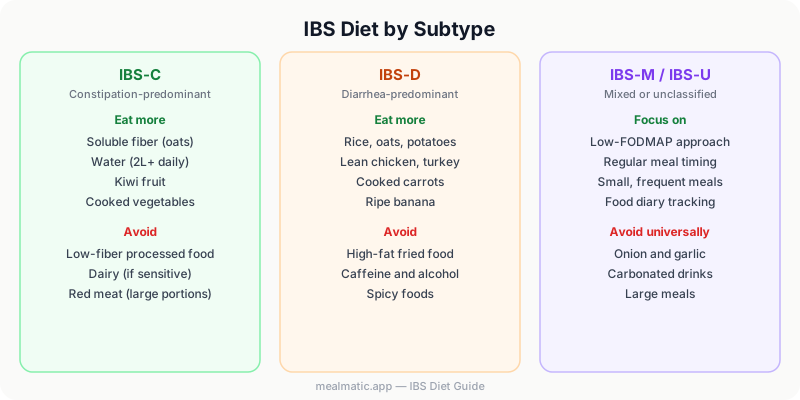
IBS-C (Constipation) — Foods to Eat and Avoid
The mechanism here is simple: stool is moving too slowly through the colon, water is being reabsorbed, and what’s left is hard and difficult to pass. The dietary fix is to bring water into the colon and keep transit moving, which means soluble fiber in steady doses plus enough fluid to hydrate the gel it forms.
Eat more.
- Oats. NICE explicitly names “oats” as the recommended soluble-fiber food for IBS. A standard portion of porridge in the morning is the easiest single change most patients make. Steel-cut, rolled, or jumbo oats all work.
- Linseeds (flaxseed). The NHS dietary guidance specifies “up to 1 tablespoon of linseeds (whole or ground) daily” — go above that amount and the insoluble bulk starts working against you.
- Kiwi fruit. A 2023 international randomised controlled trial published in the American Journal of Gastroenterology followed 61 IBS-C patients eating two green kiwifruits per day for four weeks and recorded a clinically meaningful increase of 1.73 complete spontaneous bowel movements per week, plus significant improvement in abdominal comfort. Two kiwis a day is now a common first-line suggestion before patients are escalated to fibre supplements.
- Cooked vegetables. Cooked carrots, parsnips, courgette, and peeled potatoes all keep the soluble pectin and lose the irritating raw cellulose. The NHS lists peeled potatoes and carrots by name among the soluble-fibre foods.
- Fluid. NICE puts the figure at “at least 8 cups of fluid per day, especially water or other non-caffeinated drinks.” Soluble fibre without enough water just sits there and makes constipation worse.
Avoid or limit.
- Low-fibre processed food. White bread, crackers, biscuits, and ultra-processed ready meals are the typical UK pattern that lands people in IBS-C in the first place.
- Dairy if you’re sensitive. Some IBS-C patients tolerate dairy fine; others find it slows transit further. A two-week dairy-free trial, then a planned reintroduction, is the cleanest test.
- Large red-meat portions. A 200g steak with no vegetables is a classic trigger for the next morning’s straining session — the protein-and-fat load slows colonic transit without supplying the fibre to balance it.
For the deeper rules on which fibre helps and which fibre wrecks IBS, read the companion piece on fiber choices for IBS.
IBS-D (Diarrhea) — Foods to Eat and Avoid
The IBS-D problem is the opposite: transit is too fast, water is not being reabsorbed, and the gut wall is hypersensitive to fat, fibre bulk, and chemical irritants. The food strategy is plain, low-fat, and built around starch that binds water back into the stool.
Eat more.
- Plain starch. White rice, oats cooked with water, peeled boiled potatoes, plain pasta. These are the classic “BRAT-adjacent” foundations of IBS-D safe eating — they’re easy to digest, don’t add bulk, and hold water.
- Lean protein. Plain grilled or poached chicken breast, turkey, white fish, and eggs. Avoid the fat-heavy cuts (chicken thighs with skin, fatty mince, fried) because the extra fat speeds transit.
- Cooked carrots. Cooked carrot is one of the few vegetables that’s well-tolerated across nearly all IBS-D patients — soluble pectin, low fermentation, gentle on the gut wall.
- Ripe banana. A small ripe banana has soluble pectin that binds water and gives a measurable thickening effect on stool form. (Overripe and brown-spotted bananas cross into high-FODMAP territory — keep them just-yellow.)
Avoid or limit.
- High-fat fried food. The NHS dietary advice for IBS lists “fatty, spicy or processed foods” first in the foods-to-avoid section. Fat is one of the strongest stimulators of the gastrocolic reflex; for an IBS-D gut that’s already hyperactive, a fried takeaway is the most reliable trigger of an early-morning flare.
- Caffeine. NICE caps tea and coffee at three cups per day. Many IBS-D patients find even one strong coffee on an empty stomach is enough to set off urgency within twenty minutes.
- Alcohol and fizzy drinks. Both are explicitly named in the NICE guidance as drinks to reduce. Beer and white wine are particularly bad because they layer fermentable carbs on top of the alcohol.
- Spicy food. Capsaicin directly activates pain and motility receptors in the gut wall.
- Large meals. Volume itself triggers the gastrocolic reflex. Three small meals beat one big plate.
- Artificial sweeteners. The NHS specifically calls out “products containing sorbitol (artificial sweetener)” — sugar-free gum, mints, and protein bars are the everyday hidden source. Sorbitol, mannitol, and xylitol are osmotic laxatives whether you have IBS or not.
Universal IBS Trigger Foods (Across All Subtypes)
A handful of foods cause symptoms regardless of which subtype you fit, because the mechanism is mechanical or fermentative rather than transit-related. These show up on the NHS, NICE, and British Dietetic Association lists in roughly the same shape.
- Onion and garlic. Both are concentrated sources of fructans, the F in FODMAP. Even a small amount in a cooked sauce is enough to trigger bloating and pain in most fructan-sensitive IBS patients. Garlic-infused olive oil (where the fructans don’t transfer to the oil) is the standard workaround.
- Cruciferous vegetables raw. Broccoli, cauliflower, cabbage, Brussels sprouts. The NHS guidance names “cabbage, broccoli, cauliflower, brussels sprouts” among the foods most often reported as causing problems. Light steaming reduces but does not eliminate the gas.
- Beans and pulses in large portions. GOS sugars (galactooligosaccharides) ferment fast in the colon. Canned chickpeas and lentils, drained and rinsed, are tolerated in small portions; dried-and-cooked beans usually aren’t.
- Carbonated drinks. The CO₂ alone triggers bloating and burping; on top of that, most fizzy drinks carry sweeteners or caffeine.
- Alcohol. Direct gut irritant plus dehydrating plus fermentable carb load (depending on the drink). NICE recommends reducing intake.
- Fatty fried food. See IBS-D — but the fat-trigger applies to IBS-C and IBS-M too, just less reliably.
- Large meals, eaten fast. The NHS guidance is direct: “do not eat too quickly.” Volume plus speed plus swallowed air is a reliable bloating trigger across all subtypes.
- Artificial sweeteners ending in -ol. Sorbitol, mannitol, xylitol, maltitol — sugar-free chewing gum, low-cal sweets, some protein bars. Universal trigger.
This list overlaps heavily with the elimination phase of the low-FODMAP diet plan, which is the formal way to identify your personal triggers from a longer master list.
IBS-Safe Meal Timing Tips
Diet composition gets all the attention, but the timing of meals shows up as a primary recommendation in every UK clinical guideline. NICE puts it first in their dietary section.
- Regular meals, no skipped ones. NICE: “Have regular meals and take time to eat.” And: “Avoid missing meals or leaving long gaps between eating.” A long gap (skipping breakfast, then a huge lunch) overloads the gastrocolic reflex when food finally arrives.
- Smaller portions, more often. Three modest meals plus one or two small snacks beat two huge plates. The rule especially matters for IBS-D, where meal volume is itself a trigger.
- Don’t eat too close to bedtime. Lying down on a full stomach worsens reflux and overnight bloating. A two-to-three-hour gap between dinner and bed is what most NHS dietitians suggest.
- Chew thoroughly. “Do not eat too quickly” is the NHS phrasing. Eating fast means swallowing more air, which goes straight to bloating. It also means food enters the small intestine in larger chunks that ferment harder.
- Hydrate steadily. Eight to ten cups (around 1.5 litres) of fluid a day per the NHS guidance, mostly water, spread across the day rather than in one or two large amounts.
The Low-FODMAP Connection
The low-FODMAP diet was developed at Monash University in Australia specifically for IBS, and it’s now the most evidence-backed dietary approach for the condition. Monash’s official position is that “IBS symptoms improve in 3 out of 4 people who follow a low FODMAP diet.” That 75% response figure is what makes it the standard escalation when basic NHS-style dietary advice doesn’t fully control symptoms.
The mechanism: FODMAPs (fermentable oligosaccharides, disaccharides, monosaccharides, and polyols) are short-chain carbohydrates that draw water into the small intestine and ferment rapidly in the colon, producing gas. In a sensitive IBS gut, the combination of water shift and gas distension is what causes pain, bloating, and altered transit. Cut the load, cut the symptoms.
Two things matter when deciding whether to try it:
It works best for IBS-D and IBS-M. The mechanism (cut fermentation, reduce gas and water shift) maps cleanly onto the IBS-D and mixed picture. The evidence in pure IBS-C is weaker — for constipation-predominant patients, fibre, fluid, and kiwi fruit usually do more than FODMAP restriction.
It is not a lifetime diet. The full low-FODMAP protocol has three phases: a strict elimination of two to six weeks, a structured reintroduction of each FODMAP group one at a time, and a long-term personalised diet that only restricts the specific FODMAPs you reacted to. NICE and the British Dietetic Association both stress that the protocol should ideally be done with a registered dietitian — strict elimination kept up indefinitely starves your gut microbiome of fermentable substrate, which causes its own problems. The full step-by-step is in our low-FODMAP diet plan.
FAQ
What foods are safe to eat with IBS flare-up?
In the middle of a flare, plain low-fat starch is the safest base — white rice, oats cooked with water, peeled boiled potatoes, plain toast — paired with lean protein like grilled chicken, turkey, or white fish. Cooked carrots and ripe banana are usually well-tolerated vegetables and fruit. Skip raw salad, fried food, dairy, alcohol, and caffeine until the flare settles, usually within 24-72 hours.
Is dairy bad for IBS?
Lactose is a FODMAP, and roughly two-thirds of IBS patients improve when they cut high-lactose dairy — milk, soft cheese, ice cream. Hard cheeses (cheddar, parmesan), butter, and lactose-free milk are usually fine because the lactose has been removed or never present in significant amounts. A two-week trial of lactose-free dairy is the cleanest way to test whether it’s a trigger for you.
Can I eat onions with IBS?
Probably not without symptoms. Onions are one of the most concentrated sources of fructans, which are the F in FODMAP, and they trigger bloating and pain in most IBS patients on testing. The standard workaround is garlic-infused olive oil for cooking — the flavour transfers, the fructans don’t — and using the green tops of spring onions instead of the white bulb.
Does stress trigger IBS symptoms?
Yes, and the gut-brain link is one of the most consistent findings in IBS research. NICE explicitly recommends psychological therapies (CBT, gut-directed hypnotherapy) for patients whose symptoms don’t respond to dietary and pharmacological treatment alone. Many patients find their flares track work pressure, exam stress, or poor sleep more reliably than they track any single food.
Is the low-FODMAP diet the best diet for IBS?
It has the strongest evidence for short-term symptom control — Monash quotes a 75% response rate — but it’s not a lifetime diet. NICE recommends it specifically when standard dietary advice and lifestyle changes haven’t worked, and only with a dietitian’s support so the reintroduction phase happens properly. For mild IBS, the basic NHS rules (regular meals, soluble fibre, less caffeine, less alcohol) often handle the problem without going to FODMAP restriction.
Living with IBS — let your meal plan match your subtype
Living with IBS and trying to figure out your triggers? MealMatics builds personalized meal plans that adapt to your IBS subtype, trigger foods, and nutritional needs. Start for free →

MealMatics Research & Editorial
Editorial & Nutrition Research Team
The MealMatics editorial team verifies every nutrition article against primary medical sources, including NHS clinical guidelines, NICE CG61, NIDDK, Monash University FODMAP research, and peer-reviewed literature in PubMed.