Foods to Avoid with Lactose Intolerance (Including Hidden Sources)
Complete guide to lactose intolerance foods to avoid — dairy ranked by lactose content, hidden sources in processed foods, and safe dairy alternatives.
Foods to Avoid with Lactose Intolerance (Including Hidden Sources)
Lactose intolerance happens when the small intestine does not make enough lactase, the enzyme that breaks lactose down into glucose and galactose. Undigested lactose moves into the colon, where bacteria ferment it, producing the gas, bloating, cramping, and diarrhea that show up within 30 minutes to 2 hours of a dairy meal. The mechanism is well understood, the symptoms are unpleasant, and the cure is removing or reducing lactose in the diet.
According to the NIDDK at the National Institutes of Health, about 68 percent of the world’s population and roughly 36 percent of people in the United States have lactose malabsorption. Not everyone with malabsorption has symptoms — only those who feel sick after lactose are clinically intolerant. The amount that triggers a reaction varies. NIDDK reports that most people with lactose intolerance can handle around 12 grams of lactose at one sitting, roughly the amount in one cup of milk, without significant symptoms.
This guide ranks dairy foods by their actual lactose content, lists the hidden sources that catch most people off guard, and explains which dairy you can usually keep eating.
Dairy Foods Ranked by Lactose Content
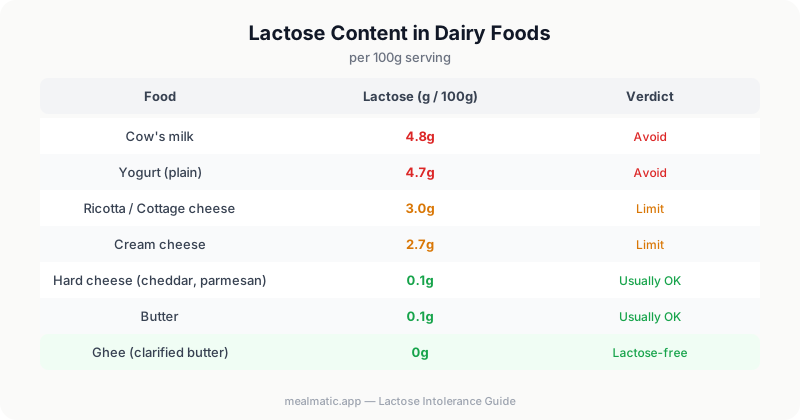
The lactose load of a dairy food depends on three things: how much milk-sugar the original liquid contained, how much was drained off during cheesemaking, and how long bacteria fermented what was left. Aged hard cheese loses almost all of its lactose; fresh soft cheese keeps most of it; butter and ghee are mostly fat and contain only trace amounts. Numbers vary slightly between sources, so the table below shows typical ranges per 100 grams.
| Food | Lactose (per 100g) | Verdict |
|---|---|---|
| Cow’s milk (whole or skim) | 4.7–5.0g | Avoid |
| Plain yogurt | 3.5–5.0g | Often tolerated in small amounts (live cultures pre-digest some) |
| Ricotta | 3.0–4.0g | Limit |
| Cottage cheese | 2.5–3.5g | Limit |
| Cream cheese | 2.5–3.0g | Limit |
| Aged cheddar | <0.1g | Usually OK |
| Parmesan | ~0g | Usually OK |
| Swiss / Emmental / Gouda | ~0g | Usually OK |
| Butter | 0.1–0.5g (per 100g; far less per pat) | Usually OK |
| Ghee (clarified butter) | 0g | Lactose-free |
A useful rule: the harder and older the cheese, the lower the lactose. Cheesemaking starts with milk, separates the curds from the whey, and then ages the curds with bacterial cultures that consume what little lactose remains. By the time a cheddar has aged for 6 to 12 months, the residual lactose is below detectable levels in most lab tests. The same is not true for fresh ricotta, cottage cheese, or quark, which never go through the long fermentation step.
Plain yogurt sits in an unusual middle zone. The bacterial cultures continue to consume lactose during refrigeration, so a yogurt that started at 5g per 100g may measure closer to 3g a week later. The live cultures themselves also produce lactase in your gut, which is why many people with lactose intolerance digest plain yogurt better than the milk it was made from. Greek yogurt, which is strained, has lower lactose still — typically around 2 to 3 grams per 100g.
Hidden Lactose Sources
The obvious dairy is easy to avoid. The trickier problem is lactose used as a food-industry ingredient — added to products that nobody thinks of as dairy. The NIDDK eating and diet guide flags six main categories. They are worth memorizing.
Bread, baked goods, and cereal. Many commercial loaves include milk powder or whey for softness and browning. Pancakes, biscuits, cookies, cakes, and instant breakfast cereals often do too. Sourdough and most artisan crusty breads do not, but the supermarket sliced loaf almost certainly does — read the label.
Processed and deli meats. Bacon, sausage, hot dogs, lunch meats, and meatloaf-style products frequently use milk solids or whey as binders and fillers. Even items labeled “all-meat” can include lactose unless the label specifies dairy-free. Plain unprocessed cuts of beef, chicken, pork, fish, and shellfish never contain lactose.
Salad dressings, sauces, and gravy mixes. Ranch, blue cheese, Caesar, creamy Italian, and most “creamy” packet dressings rely on milk powder. Powdered gravy, instant soup, and dry seasoning blends often slip lactose in as a bulking agent or carrier for flavorings.
Margarine and “non-dairy” creamers. Many margarines include whey or milk solids despite being marketed as butter alternatives. Coffee creamers and whipped toppings labeled “non-dairy” are allowed by US labeling rules to contain caseinate (a milk protein) and small amounts of lactose. If lactose is the issue, the words “non-dairy” alone do not guarantee anything — read the ingredient list.
Meal-replacement shakes, protein bars, and powders. Whey protein concentrate is the cheapest, most common protein source in commercial bars and shakes. It contains residual lactose. Whey protein isolate and casein are more processed and lower in lactose, but only certified lactose-free products are reliably safe.
Prescription and over-the-counter medications. This one surprises people. Lactose is a common filler and binder in tablets, capsules, and chewables — especially generic brands. The amount per pill is small, but a person taking multiple medications daily can accumulate enough to trigger symptoms. If you have severe lactose intolerance, ask your pharmacist for a lactose-free formulation or a brand that uses a different excipient.
When you read a label, the words to scan for are: milk, lactose, whey, curds, milk by-products, dry milk solids, nonfat dry milk powder, casein, caseinate, milk sugar, butterfat. Any of those mean lactose is present, even in trace amounts. The phrase “non-dairy” on the front of the package does not mean lactose-free. Only “lactose-free” or “0g lactose” certified labels guarantee that.
Dairy Foods Low Enough to Tolerate
A lactose-intolerant diet does not have to mean zero dairy. The NIDDK explicitly recommends keeping low-lactose dairy in the diet for calcium, protein, and vitamin D, since cutting all dairy increases the risk of bone-density problems. Four categories are usually safe.
Aged hard cheeses. Cheddar (especially sharp, 6+ months), parmesan, romano, Swiss, gouda, manchego, and most semi-hard aged cheeses contain less than 0.5 grams of lactose per ounce. A typical serving lands well under 1 gram, far below the 12-gram threshold most people tolerate. The longer the aging, the lower the lactose.
Butter and ghee. Butter is roughly 80 percent fat, 16 percent water, and only a small fraction milk solids. The lactose that remains is usually under 0.1 gram per tablespoon — too little to trigger symptoms in most people. Ghee is butter with the milk solids fully removed, leaving pure butterfat with no measurable lactose. Both work as everyday cooking fats for people with lactose intolerance.
Lactose-free milk and yogurt. These are real dairy products with the enzyme lactase added during processing. The lactase pre-digests the lactose into glucose and galactose, which is why lactose-free milk often tastes slightly sweeter than regular milk. Nutritionally it matches regular dairy gram-for-gram in calcium, protein, and vitamin D.
Plain yogurt and kefir, in small amounts. The live bacterial cultures continue to digest lactose during storage and inside your gut. Most people with mild-to-moderate lactose intolerance handle 100 to 150 grams of plain yogurt without trouble, especially if eaten with other food. Greek yogurt and skyr, which are strained, are even lower. Skip flavored yogurts — added sugar plus lactose plus sometimes added milk powder makes them worse.
If you are managing other intolerances at the same time, our guide to low-FODMAP foods explains how lactose fits into the broader IBS picture, and you can convert dairy recipe measurements when you scale a recipe up or swap milliliters of milk for grams of plant cream.
Dairy-Free Alternatives for Cooking and Baking
The plant-milk aisle has expanded fast, and not every alternative behaves the same in the pan. Here is what each one does well.
Oat milk. The closest in mouthfeel to whole cow’s milk because of its natural starch. Foams well for coffee, works in sauces and soups, and bakes into a tender crumb. Slightly sweet on its own, so reduce sugar by 1 to 2 tablespoons per cup in baking. Look for “barista” versions if you want stable foam.
Soy milk. Highest protein of the plant milks at around 7 to 8 grams per cup, which makes it the best 1:1 baking substitute for cow’s milk in cakes, custards, and béchamel-style sauces. It curdles in acidic recipes (lemon, tomato), so add it at the end of cooking. The flavor is more pronounced than oat — fine in chocolate or coffee, less ideal in delicate vanilla.
Almond milk. Thinner and lower in protein, around 1 gram per cup. Works in smoothies, oatmeal, and quick breads but produces a drier crumb in cakes. Choose unsweetened, unflavored versions for cooking — the vanilla and sweetened versions throw off savory recipes.
Coconut milk. Two products with one name. Coconut beverage (in the carton) is a thin drinking milk; coconut milk in a can is a thick high-fat cream meant for cooking. Use canned coconut milk for curries, dairy-free ice cream, and rich sauces; the carton version for breakfast cereal and drinking. Strong coconut flavor in some brands — read labels if you want a neutral one.
Cashew cream and oat cream. Soaked and blended raw cashews make a thick, neutral cream that replaces heavy dairy cream in pasta sauces, soups, and dips. Oat cream (sold pre-made in some countries) is a lighter alternative that pours from a carton.
Plant-based butter. Block-form vegan butter (brands like Miyoko’s, Country Crock Plant Butter, Naturli) has enough fat content to laminate pastry, cream with sugar, and brown like dairy butter. Spread-form tubs are softer and better suited to toast than to baking.
For broader dairy-free baking substitutions — including how to handle gluten-free flours alongside the dairy swaps — the same principle applies: match the substitute to what the original ingredient was actually doing in the recipe, and adjust other liquids if the new ingredient brings extra moisture.
Reading Food Labels for Lactose
US and EU labeling laws require allergen disclosure for milk, but the wording varies. A few practical rules cut through most of the confusion.
“Contains milk” vs “may contain milk.” “Contains” means milk is an intentional ingredient — skip the product. “May contain” means cross-contamination is possible because the food was made on shared equipment. For lactose intolerance specifically, “may contain” trace amounts is usually fine; for true dairy allergy, treat both warnings as a stop sign. Lactose intolerance and milk allergy are different conditions with different thresholds.
Ingredient terms that mean lactose. Beyond the obvious “milk” and “lactose,” look for: whey, whey protein concentrate (WPC), whey protein isolate (WPI), casein, caseinate (sodium, calcium, potassium), curds, milk solids, milk powder, nonfat dry milk, buttermilk solids, ghee solids (rare), recaldent, lactalbumin, lactoglobulin.
Ingredients that are dairy-free despite the name. Cocoa butter, shea butter, peanut butter, almond butter, cream of tartar, coconut cream, and “creamer” (when explicitly non-dairy and free of caseinate) are all lactose-free. Lactic acid is usually fermented from corn or beets, not milk, despite the name — but check the label for products marketed to severe-allergy customers.
Kosher pareve. A “pareve” certification on a kosher label means the product contains no dairy and no meat. It is the most reliable single label for dairy-free, more conservative than “non-dairy.”
When in doubt, the ingredient list trumps the front-of-package marketing. Read it, and if any of the lactose terms above appear, the food contains lactose.
Frequently Asked Questions
Q: Is lactose intolerance the same as a milk allergy?
No. Lactose intolerance is a digestive issue — the small intestine cannot break down milk sugar, and undigested lactose causes gas and bloating. A milk allergy is an immune reaction to milk proteins (casein or whey), and the symptoms include hives, swelling, vomiting, and in rare cases anaphylaxis. Tiny amounts of lactose are usually fine for intolerant people; even tiny amounts of milk protein can be dangerous for someone with a milk allergy.
Q: Can I eat butter if I’m lactose intolerant?
Most people with lactose intolerance tolerate butter without issue. Butter is roughly 80 percent fat with only trace lactose — usually under 0.1 grams per tablespoon. A normal cooking or spreading portion is far below the threshold that triggers symptoms. If you have severe lactose intolerance and react to even small amounts, switch to ghee, which has the milk solids fully removed and contains no measurable lactose.
Q: Is Greek yogurt low in lactose?
Yes, lower than regular yogurt. Straining removes a portion of the whey, where most of the lactose sits, leaving Greek yogurt at roughly 2 to 3 grams of lactose per 100g compared with 4 to 5 grams in unstrained plain yogurt. The live cultures also continue to digest lactose during refrigeration. Most people with mild lactose intolerance handle a 150g serving without trouble. Skip flavored versions — added milk solids and sugar push the lactose load back up.
Q: How much lactose can I tolerate?
The NIDDK reports that most people with lactose intolerance handle about 12 grams of lactose in one sitting — roughly the amount in one cup (240 ml) of milk — without significant symptoms, especially when eaten with other food. Tolerance is individual: some people react to 5 grams, others handle 20 grams or more. The practical approach is to introduce small amounts and track symptoms, rather than cutting all dairy permanently.
Q: Do lactase enzyme supplements work?
Yes, for most people, when timed correctly. Lactase pills (sold as Lactaid, Dairy Ease, and store-brand equivalents) provide the enzyme your gut is missing, breaking down lactose before it ferments. Take them right before the dairy meal — taking them after symptoms start is less effective. Dose depends on the product and the meal: a small splash of milk in coffee may need one pill; a slice of pizza with cheese might need two or three. They work for occasional indulgences but are not a substitute for diet management if you eat dairy daily.
Managing lactose intolerance or other dietary restrictions? MealMatics builds personalized meal plans that automatically exclude your trigger foods and suggest dairy-free swaps with matched protein and calcium content. Start for free →

MealMatics Research & Editorial
Editorial & Nutrition Research Team
The MealMatics editorial team verifies every nutrition article against primary medical sources, including NHS clinical guidelines, NICE CG61, NIDDK, Monash University FODMAP research, and peer-reviewed literature in PubMed.